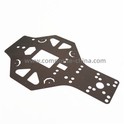


FRP composites are used in both construction and industry. They are often used as substitutes for traditional materials such as wood, steel or aluminum to replace I-beams, angles, channel steels, pipes and similar structural shapes. FRP composites can also replace sheet metal and have a variety of uses. The adaptability of FRP enables it to be used in applications such as: walkways (including grilles, handrails, and structural members), platforms, stair structures, sidewalks, handrails, and fences.
As a common molding process, pultrusion is designed to produce a reinforced polymer structure of continuous length with a consistent cross-sectional profile. The process stretches the raw material by using a heated steel forming mold using the continuous stretching principle, resulting in a strong structural composite. While many people are familiar with the extrusion process, which involves pushing granules or chopped fibers into a mold, the pultrusion process features a continuous length of reinforcement that is continuously pulled out through the mold.
FRP can offer many advantages that make it extremely attractive. Among the most important advantages are:
High strength: The strength of pultruded FRP is comparable to or higher than the strength of structural steel.
Light weight: pultruded FRP profiles are 75-80% lighter than steel and 30% lighter than aluminum. This weight reduction effectively reduces transportation costs, simplifies the installation process, and reduces the overall weight of the assembled structure.
Corrosion resistance: When the right resin is selected, FRP is not affected by various corrosive environments. FRP does not rust or rot.
Low thermal and low electrical conductivity: FRP based on glass fiber reinforcement is an excellent insulator with minimal thermal and electrical conductivity. This quality makes it the first choice for applications involving temperature sensitivity or electrical issues.
Electromagnetic Transparency: Glass fibers allow the passage of radio waves, microwaves, and other electromagnetic frequencies, making fiberglass-based FRPs ideal for honeycomb applications.