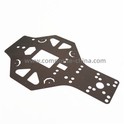


With the rapid development of UAV technology, composite materials are increasingly used in the manufacturing of UAV parts. Composite materials provide UAVs with higher performance and longer service life due to their light weight, high strength and corrosion resistance. However, the processing of composite materials is relatively complex and requires sophisticated process control and efficient production technology.
1. Processing characteristics of UAV composite parts
The processing of composite parts for drones needs to take into account factors such as the characteristics of the material, the structure of the parts, and production efficiency and cost. Composite materials have high strength, high modulus, good fatigue resistance and corrosion resistance, but they also have the characteristics of easy moisture absorption, low thermal conductivity, and high processing difficulty. Therefore, during the processing, the process parameters need to be strictly controlled to ensure the dimensional accuracy, surface quality and internal quality of the parts.
2. Various processing technologies of drones
-- Autoclave molding process
Autoclave molding is one of the commonly used processes in the manufacturing of composite parts for drones. This process is to seal the composite blank on the mold with a vacuum bag, place it in an autoclave, and use high-temperature compressed gas to heat, pressurize and solidify the composite material under vacuum. The advantages of the autoclave molding process are uniform pressure and resin content in the tank, and the mold is relatively simple and efficient, which is suitable for the molding of large-area and complex-surface shells. However, this process also has disadvantages such as high energy consumption and large consumption of auxiliary materials. Therefore, it is necessary to optimize process parameters such as temperature, pressure and time during the processing to improve production efficiency and reduce costs.
-- HP-RTM Process
The HP-RTM process is an optimized upgrade of the RTM process, with the advantages of low cost, short cycle, large batch, and high-quality production. This process uses high pressure to hedge and mix the resins, and injects them into a vacuum-tight mold pre-laid with fiber reinforcements and pre-set inserts. After resin flow filling, impregnation, curing and demolding, composite products are obtained. The HP-RTM process can produce small complex structural parts with small dimensional tolerances and good surface finish, and achieve consistency of composite parts. However, the size of the parts that can be manufactured is limited, and due to the high resin pressure and loose fiber compaction, the dispersed fibers may be washed away. Therefore, during the processing, it is necessary to strictly control the metering, mixing and injection process of the resin, as well as the design and manufacturing accuracy of the mold.
-- Compression molding process
The compression molding process is a process method in which a certain amount of prepreg is placed into the mold cavity of a metal mold, and a press with a heat source is used to generate a certain temperature and pressure, so that the prepreg is heated and softened in the mold cavity, flows under pressure, fills the mold cavity and solidifies into a shape. The advantages of the compression molding process are high production efficiency, accurate product size, and smooth surface. In particular, composite products with complex structures can generally be formed in one time without damaging the performance of composite products. However, this process also has disadvantages such as complex mold design and manufacturing and large initial investment. Therefore, it is necessary to optimize the mold design and manufacturing process during the processing, as well as to improve the degree of automation of the production line.
-- 3D Printing Technology
3D printing technology can quickly process and manufacture complex precision parts, and can achieve personalized production without molds. In the production of composite parts for drones, 3D printing technology can be used to manufacture integrated parts with complex structures, reducing assembly costs and time. The main advantage of 3D printing technology is that it can break through the technical barriers of preparing one-piece complex parts by traditional molding methods, improve material utilization and reduce manufacturing costs. However, this process also has disadvantages such as slow printing speed and high equipment cost. Therefore, it is necessary to select appropriate printing materials and parameters during the processing, as well as optimize the performance and stability of the printing equipment.
Efficient processing of composite parts for drones is of great significance for improving the performance of drones and reducing costs. By optimizing process parameters and process control such as autoclave molding, HP-RTM, compression molding and 3D printing, production efficiency and product quality can be further improved. In the future, with the continuous advancement and innovation of technology, we can expect more optimized production processes to be widely used in the drone manufacturing industry. At the same time, it is also necessary to strengthen the basic research and application development of composite materials to promote the continuous development and innovation of drone composite parts processing technology.