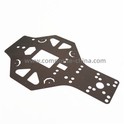


There are various connection methods for composite connections, which need to be selected according to the load characteristics applied to different connection areas, etc. At this stage, the main methods of carbon fibre composite connection are mechanical connection and adhesive connection.
Glued joints
A glued joint is the joining of two or more members together with an adhesive. Today, glued joints are generally divided into 3 categories: co-curing, co-gluing and secondary gluing. However, when we usually refer to glued joints, we usually mean secondary glued joints or co-glued joints. The performance of co-curing preformed glued joints is much better than that of co-glued joints. Glued connection form can be divided into two main categories: plane-type lap and orthogonal form of connection. Plane-type laps are mainly subjected to in-plane tensile loads, and the adhesive layer is subjected to shear forces, which are mostly used for the connection between plate members in aircraft structures; orthogonal-type laps are mainly subjected to out-of-plane tensile loads, commonly known as pull-off loads, which are mainly used for the connection between plate members and beams, ribs, trusses, and so on.
Mechanical connection
A mechanical connection is a method of joining two or more connected members together using mechanical means, usually bolts and rivets. Commonly used mechanical connections in aircraft structures include bolts, rivets, blind fasteners and ring groove rivet connections. The mechanical connection of carbon fibre composite structure exists a variety of connection forms, according to the different stresses of its fasteners can be divided into single shear and double shear two categories; according to the connection with or without lap plate to connect the transition role, divided into lap and butt; each connection form there will be a corresponding form of slash connection, the selection of carbon fibre composite material mechanical connection form should pay attention to: single shear lap form there will be a certain bending Deformation, will reduce the connection strength, reduce the efficiency of the connection, therefore, the connection design should be used in the form of double-shear connection; due to the existence of bending stress, for the asymmetric single-lap connection structure, should be used for multi-row nail connection, and increase the row spacing; carbon fibre resin-based composite material multi-row fasteners connected to the presence of load distribution of serious non-uniformity, it should be noted that it is not appropriate to use the number of rows of nails too much of the structural form. In the multi-peg connection structure, in order to improve the connection strength of the structure, especially the fatigue strength, the location of the bolt holes try to use parallel arrangement, avoid staggered arrangement; reasonable design of the variable thickness plate slash type connection can improve the load carrying capacity of the connection structure, and the slash connection form will make the load carrying capacity decrease when it is not reasonably designed.