

Currently, after achieving initial technological breakthroughs, my country's humanoid robot industry is gradually entering a critical transformation period of large-scale implementation. Standardization has become the core approach to promoting the industry's standardized development and breaking through development barriers.
Recently, the Standardization Technical Committee for Humanoid Robots and Embossed Intelligence under the Ministry of Industry and Information Technology officially released the "Standard System for Humanoid Robots and Embossed Intelligence ( 2026 Edition)". This is the first top-level design specification in China covering the entire industrial chain and life cycle of humanoid robots. It completely fills the gap in systematic industry standards and marks the formal shift of China's humanoid robot industry from single technological innovation to a new journey of standardized and collaborative high-quality development, laying a solid institutional foundation for the industry to achieve large-scale expansion.
In recent years, China's humanoid robot industry has developed rapidly, with its independently developed achievements frequently making headlines. These achievements have not only shone brightly in domestic cultural and sports performances but have also attracted widespread attention in the global market, continuously enhancing its international influence. The industry has seen significant expansion; by 2025, the number of domestic humanoid robot manufacturers had exceeded 140, launching over 330 different products, and the industrial ecosystem is gradually improving.

However, from an overall development perspective, my country's humanoid robot industry is still in its initial stage, with a significant gap to bridge before reaching maturity and large-scale deployment. It faces several pressing development bottlenecks: First, the insufficient generalization ability of AI models results in poor adaptability to various scenarios, making it difficult to meet the complex operational needs of diverse environments. Second, the high dependence on foreign suppliers for core components directly increases overall production costs and squeezes profit margins. Third, the fragmented nature of application scenarios and the lack of unified implementation standards further hinder large-scale promotion. Among these, data scarcity has become the primary obstacle to accelerated industry development. Only by achieving interconnectivity between devices and building dedicated industry-specific models can the core pain points of intelligent development be addressed. This requires collaborative efforts and joint breakthroughs across the entire industry chain.
Industry insiders generally believe that embodied intelligence is rapidly transitioning from the research stage to the industrial application stage, and humanoid robots are expected to become the next generation of super terminals after smartphones and new energy vehicles, with huge market development potential. Based on industry research and market demand, the cultural and entertainment, silver economy, and industrial services sectors have become the core growth drivers for the humanoid robot industry in the short to medium term: In the cultural and entertainment sector, humanoid robots, with their unique performance attributes, demonstrate unique value in attention-driven scenarios such as Spring Festival Gala performances and cultural tourism concerts, resulting in continuously rising market attention; in the silver economy sector, the aging population creates a huge market gap for basic elderly care and emotional companionship, and the companionship function of humanoid robots has broad application potential; in the industrial services sector, relying on standardized systems to reduce deployment and maintenance costs, humanoid robots can be widely used in factory operations, supermarket services, and other scenarios, empowering the transformation and upgrading of traditional industries.
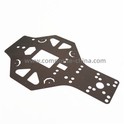
The implementation of the humanoid robot standard system has brought new development opportunities to the upstream composite materials industry, directly driving the large-scale demand for high-end composite materials and broadening the industrial application track. The lightweight, high-strength, and high-toughness hardware requirements of humanoid robots have made carbon fiber composites, special engineering plastics, and flexible polymer materials the core materials to be selected. The specifications for limbs and components, as well as the entire system, in the standard system further unify material performance and compatibility standards, breaking down downstream selection barriers and promoting the extension of composite materials from traditional fields such as aerospace and automotive to the emerging humanoid robot track, effectively releasing market growth and helping the industry overcome application scenario limitations.
Although the industry still faces multiple bottlenecks in technology, cost and application scenarios, with the implementation of standards and the collaborative efforts of the entire industry chain, the humanoid robot industry will gradually break through development constraints, accelerate the implementation in diverse scenarios, and truly achieve a leap from technological breakthroughs to large-scale development, helping my country to seize the initiative in the global humanoid robot industry competition.