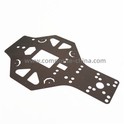


Carbon Fiber Prepregs can be formed using a variety of methods, and the most appropriate method is selected based on the application.
Prepreg forming processes include vacuum bagging, autoclaving, compression molding, pultrusion , filament winding And pressure bagging .
Among them, the vacuum bag process is mainly used for interior decoration in the shipbuilding industry and railway systems, the autoclave process is mainly used for high-quality composite materials, the molding process is mainly used for flat panels, sporting goods, sleds, and industrial products, the tube winding process is mainly used for fishing rods, ski rods, golf clubs, and pipe fittings, and the pressure bag process is mainly used for masts, antenna poles, and various pipe fittings.
1. Vacuum bag process
The vacuum bag molding process is a molding process in which the product is sealed between the mold and the vacuum bag, and the product is pressurized by vacuuming to make the product more dense and have better mechanical properties.
2. autoclave molding technology:
Uniform pressure inside the tank, fast, uniform air temperature inside the tank, high precision, high quality, wide adaptability, suitable for batch production, and reliable molding process; the disadvantages are high cost and large initial investment.
3. Winding:
Winding is a process whereby a winding machine controls the tension and winding angle, wrapping prepreg in a specific pattern around a core mold, and curing to form a composite part. This process is only suitable for rotating tubular products.
The reinforcing materials used in winding are primarily fiber yarns of various strengths . Unsaturated polyester resins are often used for general civilian products such as pipes and tanks. Epoxy resins can be used for wound products that require high mechanical properties such as compressive strength and interlaminar shear strength.
4. Compression Molding
Advantages of compression molding: High production efficiency, easy to achieve specialized and automated production; high product dimensional accuracy and good repeatability; smooth surface, no need for secondary modification; can form complex structures in one step; mass production, low price.
However, the compression molding process has complex mold manufacturing, high mold quality requirements, high molding pressure, large equipment investment, and is limited by the press. It is most suitable for batch production of small and medium-sized composite materials. With the continuous improvement and development of metal processing technology, press manufacturing level and synthetic resin process performance, the tonnage and table size of the press are constantly increasing, and the molding temperature and pressure of the molded material are relatively reduced, which makes the size of the molded products gradually develop towards large-scale. At present, it can produce large automotive parts, bathtubs, integral bathroom parts, etc.
5. pultrusion process
involves extruding prepreg under traction, shaping it through an extrusion die, and curing it to continuously produce FRP profiles of unlimited length. This process is most suitable for producing FRP profiles of various cross-sectional shapes, such as rods, tubes, solid profiles (I-shaped, channel-shaped, square profiles), and hollow profiles (door and window profiles, blades, etc.).